
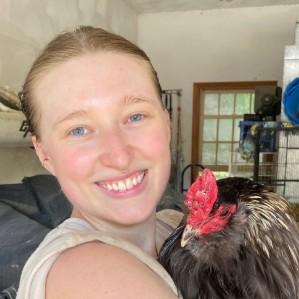
Environmental Science and Data Analytics graduate passionate about leveraging field ecology and quantitative modeling to advance data-driven ecological research. Experienced in bat population sampling, GIS-based algal bloom prediction, habitat preservation, invasive species management, and animal husbandry; I seek to combine field experience with data science principles, such as machine learning, predictive modeling, and statistical analysis. Ultimately, I am driven to study anthropogenic impacts on species and their ecosystems, working to implement nature-based solutions to aid species adaptation in affected environments.
Work History
Animal Care Staff
6 Months- Managed feeding routines for sanctuary animals, providing tailored diets and fresh water to meet nutritional needs.
- Facilitated safe handling, restraint, and transport of rescued animals, enhancing their well-being during care activities.
- Maintained barn, stall, paddock, and bedding conditions, ensuring optimal animal comfort and hygiene.
Global WFM Forecasting Senior Data Analyst
2 Years 5 Months- Forecast 300k+ weekly global contacts, ensuring multi-region operational readiness.
- Automate core workflows using SQL and Python, driving significant gains in process efficiency.
- Empower stakeholders with real-time dashboards and ad hoc insights to guide decision-making.
Barista
1 Year 3 Months- Prepared high-quality food and beverage orders while managing POS cash, card, and mobile transactions.
- Maintained strict food safety and sanitation standards in a high-volume retail environment.
Calculus I Faculty Assistant
2 Months- Customized teaching approaches to enhance individual student confidence and comprehension of course material.
- Led weekly course review meetings to monitor progress and address instructional needs.
- Tracked attendance and graded documentation to ensure accurate student records.
Outside Lawn & Garden Associate
2 Months- Maintained live plant health and presentation.
- Processed customer orders, loaded materials, and maintained garden inventory.
Education
Bachelor of Science - Earth, Environment, and Global Sustainability Studies & Data Analytics
- Summa Cum Laude
- GPA: 3.81
- GRE: 318
Skills
PROJECTS:
Coral Reef Bleaching Prediction - Introduction to Machine Learning [Fall '23]:
Informed coral reef bleaching remediation efforts using EDA and ML models, such as RF, NN, KNN, and ensembles, and evaluated appropriate predictive performance evaluation metrics for final model determination.
Independent Study in Water Quality Modeling in R [Spring '22]:
Conducted GIS analysis of Lake Okeechobee's water quality, using satellite data to identify and predict toxic algal blooms through data processing and interpretation using several R packages.
VOLUNTEER EXPERIENCE:
Goat Tender & Invasive Removal Volunteer at Mass Audubon's Habitat Education Center & Wildlife Sanctuary in Belmont, MA (August 2024 - May 2026):
- Assist with the wellbeing of the sanctuary's working goat herd (i.e. medication, mucking, hoof & coat care, feeding, etc.).
- Educate visitors on the working herd's role, dynamics, habits, and the importance of nature conservation.
- Perform manual invasive species removal and habitat restoration using heavy-duty tools and field techniques.
Seasonal Bat Research Volunteer at Mount Auburn Cemetery in Cambridge, MA (October - November 2024): Surveyed bat populations using visual and acoustic data collection to assess presence and health.
RELEVANT COURSEWORK:
Oceanography
Description: Explored marine ecosystems, such as mangroves, coral reefs, and seagrass meadows, examining their interconnections with climate change, human influence, and economic factors.
Introduction to Generalized Linear Models and Survival Analysis in Business
Description: Applied an end-to-end data analysis workflow, from exploratory analysis and model selection to assumption verification, fitting Generalized Linear Models with Poisson, Binomial, and Gamma distributions and interpreting non-linear coefficients.
Fall 2023
Introduction to Generalized Linear Models and Survival Analysis
Description: Applied statistical methods to handle complex, non-normal data distributions and analyze risk/survival outcomes.
Data Science
Description: Employed advanced data science techniques to process, analyze, and extract insights from large datasets.
Spring 2023
Global Climate Change
Description: Conducted climate risk assessments, analyzed natural disasters, water quality, and infrastructure risks; modeled Earth systems (feedback loops, water supply, biodiversity) and developed data-driven mitigation strategies.
Database Management Systems
Description: Designed, implemented, and queried relational databases using SQL, incorporating Entity-Relationship Diagrams (ERDs) for comprehensive data management.
Data Mining
Description: Extracted patterns and trends from complex datasets (including Python-based National Park biodiversity assessments).
American Environmental History
Description: Analyzed the legal and political history of environmental law, examining the intersections of conservation policy, public spaces, and engineering practices.
Fall 2022
Principles of Geology
Description: Explored geological principles, earth systems, and performed rock identification on local rock samples.
Design of Experiments
Description: Constructed robust experimental designs, employing statistical models and diagnostic tools in RStudio.
Introduction to Machine Learning
Description: Built predictive and analytical machine learning models to automate workflows and evaluate complex datasets.
Regression Analysis
Description: Performed multi-variable statistical modeling and evaluated diagnostic metrics.
Spring 2022
Introduction to Programming with Python
Description: Developed foundational coding skills, data structures, and automation scripts.
Data-Driven Decision Making
Description: Applied quantitative modeling to business and environmental decision frameworks.
Fall 2021
Environmental Chemistry
Description: Detected environmental pollutants, synthesized biofuels for sustainable energy use, and evaluated renewable energy sources.
Intermediate Applied Statistics
Description: Advanced statistical testing, hypothesis formulation, and quantitative analysis.
Spring 2021 & Prior
Environmental Science and Sustainability
Description: Covered foundational ecological principles, human-environment interactions, and sustainability frameworks.
Calculus I & II
Description: Built core mathematical foundations for quantitative modeling and systems analysis.
Interests
- GIS and spatial modeling
- Mammalian, ungulate, and avian ecology
- Anthropogenic impact research
- Ecological restoration
- Roadway ecology
- Nature-based solutions
LEADERSHIP & COMMUNITY
President, SAGE (Gender Equity) Student Organization at Bentley University
Co-president, PRIDE (LGBTQ+) Student Organization at Bentley University