

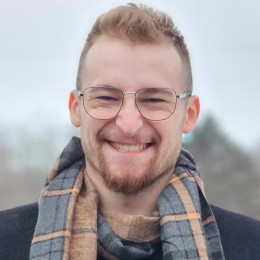
Wyatt Buckbee
Roseville,MI
Summary
Versatile nuclear engineering graduate with a strong foundation in neutron and gamma radiation detection and computational modeling. Experience in fabrication processes and technical documentation enhances problem-solving capabilities. Proven ability to integrate scientific detector principles with practical applications during a college engineering team design project for a UAV based neutron and gamma radiation detection and gamma spectroscopy platform. Currently seeking engineering or technical roles involving MCNP modeling techniques, mechanical systems design and review, and radiation detection or detection system design/troubleshooting.
Overview
8
8
years of professional experience
Work History
Cashier/ Parts Seller
US Auto Sterling Heights
Sterling Heights, Michigan
07.2024 - Current
I currently work as an automotive parts seller providing customer service and accurate inventory records. I help customers locate vehicles within our yard, and assist them in finding the correct type of part for their individual project. I also provide vehicle repair and maintenance guidance to customers through my personal experience working with my personal vehicle.
- Processed customer transactions using point-of-sale systems efficiently.
- Handled returns, exchanges, and customer complaints professionally, ensuring customer satisfaction and loyalty.
- Collaborated with team members to streamline checkout procedures.
- Trained new staff on work procedures and customer service standards.
- Exceptional customer service skills and customer-company interaction management skills.
- Give up to date information on vehicle availability across managed inventory systems.
- Provided new product theft prevention methods to minimize sale losses.
Cad File Transfer
Electrolabs
Fraser, MI
01.2019 - 08.2021
I worked as a fabrication shop hand using power tools and CNC lasers to make a variety of parts in large orders. Created custom Gcode files from technical drawings and modified existing Gcode files to ensure accurate part production.
- Operated two industrial fabrication lasers: Amada Ensis 3015 and Pulsar 2415NT.
- 2 years TIG/MIG Welding experience
- Hand Power tool usage
- G-Code File Program Creation/Editing
- Part Design and Solution Creation
Education
Bachelor of Science - Nuclear Engineering
University of Michigan
Ann Arbor, MI04-2026
Some College (No Degree) - Mechanical Engineering
University of Michigan
Dearborn, MISkills
- 5 years Vehicle Maintenance and Repair
- Power tool use
- Hand tool use
- Mechanical troubleshooting
- Inventory management
- Technical documentation
- 5 years Microsoft Office experience
- Team collaboration
- Communication skills
- Work ethic and integrity
- Dependability, Reliability, and Punctuality
- Professionalism and Courtesy
- Finite Difference Modeling
- Pulse Shape Discrimination (PSD) algorithm Development
- Uranium Nuclear Fuel Cycle Knowledge
- Radiation Simulator Personal Project
- Calculus Based Problem Modeling
- Organic Glass Scintillator Usage
- 1 years Thermohydraulic Modeling and Solving
- Technical Literature Review Skills
- Monte Carlo Simulation Methodology
- Radiation Transport Modeling
- 2 years Differential Equation Solving
- 1 year Gamma Spectroscopy Lab Experience
- He-3 Proportional Counter Usage
- Experimental Detector Characterization
- 5 years Additive and Subtractive Manufacturing Experience
- Mechanical Design
- Basic Drafting Knowledge
- Nuclear Measurement Data Analysis
- 3 years MATLAB Programming and Debugging
- Nuclear Measurement Best Practices
- Radiation Detection and Measurement Techniques and Safety Practices
- 5 years 3D Printing Hobby Experience
- 5 years G-code programming
- 2 years Fabrication Procedure Experience
Affiliations
- Competitive Swimmer, 2016-2021
- 3D Printing Hobbyist, 2015-Present
UAV-Mounted Neutron-Gamma Detection System
I participated in a design project at Ann Arbor in my senior year of college. The goal of the project was to design and test components of a neutron and gamma detection system capable of on board pulse shape discrimination, and gamma spectroscopy. The project aimed to serve as an emergency response tool, and cleanup assisting device. The tested system successfully performed gamma spectroscopy and neutron counting and quantification with MCNP based simulations to predict detector response. The project was a success and provided a way for me to enhance my engineering design and workflow based skills. I served as the main MCNP 6.3.1 and Polimi programmer, provided data analysis techniques for measurement data, and analyzed simulation data to better quantify our systems behavior and improve our simulation confidence through variance reduction methods within MCNP input files. This project was aided by Shaun Clarke , Sarah Pozzi, and David Breitenmoser of the University of Michigan as project mentors and allowed my team to learn MCNP techniques directly from those involved with the programs development.
References
Scott Suddon
General Manager/Co-owner
Electrolabs
Phone: (586) 713-4584
Note: Scott oversaw my work at Electrolabs and was my direct supervisor.
Kortnie McBride
General Manager
Us Auto of Sterling Heights
Phone: (586) 610-0502
Note: Kortnie was my manager during my work with Us Auto Supply.
Nuclear Lab Experience
I have undertaken a total of 4 semesters of nuclear engineering centered labs during my time at Michigan's Ann Arbor campus. The labs consisted of radiation detection methods, nuclear data analysis and methods, Experiment recreation within MCNP and Polimi codes, and detector system troubleshooting and design. I worked with organic scintillators and detectors based around different detection methods. Lab procedures consisted of measuring uranium sources and determining U-235 enrichment with an HPGe crystal detector, neutron counting of an accelerator activated Deuterium source, and analyzing pulse shape discrimination algorithms to improve a detector systems ability to discriminate between detected neutrons and detected photons. In my time I was mentored by Dr. Shaun Clarke an associate research scientist and professor who worked on the development of the MCNP Polimi Extension directly, and was a major help in developing my personal MCNP input files, and simulation methods. During my senior lab with Dr. Clarke I studied the various radiation interaction methods with matter and how they translate into MCNP and other Monte Carlo Based Simulations. The methodology and inner workings of the MCNP code were explained to me so that I could accurately reproduce real measurement data from sources I programmed and troubleshooted myself. The labs required me to connect radiation interaction physics with real detector behavior, verifiable uncertainty, and engineering computational modeling. A strong foundation in radiation transport, detection physics, and data analysis gained from these labs has allowed me to design my own experiments, troubleshoot lab equipment, develop real world pulse discrimination algorithms, and analyze simulation results alongside real world measurement data to develop emerging detector systems.
Timeline
Cashier/ Parts Seller
US Auto Sterling Heights
07.2024 - Current
Cad File Transfer
Electrolabs
01.2019 - 08.2021
Bachelor of Science - Nuclear Engineering
University of Michigan
Some College (No Degree) - Mechanical Engineering
University of Michigan